.jpg)
The first question we get about dry needling is usually some version of "isn't that just acupuncture?" The second one, almost always, is "does it actually work?" Both deserve real answers, not the marketing version.
So the short answer to question one: no, it's not acupuncture, even though the needles look almost identical. And the short answer to question two: yes, for specific things, and the research has gotten quite a bit stronger over the last decade. The longer answer is more interesting, and it's worth getting right if you're trying to figure out whether this is the right tool for whatever you have going on. Or, more usefully, the right tool to know about before you have anything going on.
It's not acupuncture, even though it looks like it might be
This is the most common point of confusion, and it's easy to understand why. Both practices use thin solid needles. Both involve putting those needles through your skin. From across the room, the procedures look identical.
The thinking behind them, though, is completely different. Acupuncture is part of Traditional Chinese Medicine, a complete framework with its own theory of how the body works (energy flowing through channels called meridians) and its own diagnostic system going back thousands of years. Needles get placed at mapped points to influence that energy flow.
Dry needling comes from a different place entirely. It uses Western anatomy, modern pain science, and a clinical reasoning process aimed at very specific neuromuscular structures, mostly something called myofascial trigger points. Practitioners aren't trying to balance anything. They're trying to mechanically reset a piece of tissue that has gotten stuck.
If you tried acupuncture and it didn't do much, that tells you almost nothing about whether dry needling would help your nagging Achilles or your cranky shoulder. They are answering different questions with similar-looking tools.
What's actually happening when the needle goes in
To understand why dry needling works for what it works for, you have to know what it's targeting.
A trigger point is, basically, a strand of muscle that got stuck in a contracted state and forgot how to relax. It's not a cramp, which resolves on its own. It's more like a section of muscle that has been quietly squeezing itself for weeks or months. You may or may not know it's there.
That sounds simple, but the downstream effects are messy. When that strand stays contracted, it physically compresses the small blood vessels around it, which starves the local tissue of oxygen. The starved tissue starts pumping out chemical signals that translate roughly to "something is wrong here." Your nervous system reads those signals and protects the area by tightening up everything around it. You end up with a knot. Sometimes the knot hurts where it is. Sometimes it refers pain somewhere else entirely (a classic example: trigger points in the upper trap producing headaches behind the eye). Sometimes it just sits there, silently changing how you move.
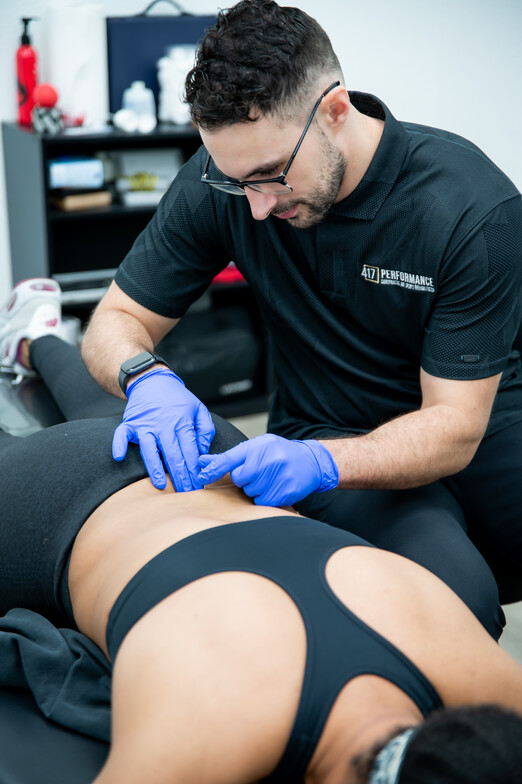
When a needle goes into a trigger point, the most dramatic thing that happens is a local twitch response. The muscle fasciculates for a moment, a brief involuntary jump that looks almost cartoonish from the outside. That twitch is functionally the muscle dumping out the chemical signal that was keeping it stuck. Once the signal clears, those fibers can finally lengthen back to where they should have been all along.
Underneath the twitch, there's a more interesting story. The needle also stimulates fast sensory nerve fibers that, at the level of the spinal cord, override the slower pain signals trying to climb up to the brain. It seems to nudge the nervous system into releasing some of its own painkillers too. Researchers studying this have measured actual changes in pain-related chemicals in the body after dry needling, so we're not just guessing that something neurochemical is going on (Rabanal-Rodríguez and colleagues, 2025).
What the research actually supports
The places where the evidence is solid are pretty specific:
Tendon problems like tennis elbow, patellar tendinopathy (the runner's-knee and jumper's-knee kind), and rotator cuff issues. When researchers pulled together the studies on this in a 2025 analysis, people doing dry needling alongside their rehab exercises consistently did better than people just doing the exercises alone. The functional gains for tennis elbow were especially clear around the three-to-four week mark (Tayyab and colleagues, 2025).
Pain reduction across a lot of common musculoskeletal issues: neck pain, shoulder pain, lower back pain. A high-quality review found that dry needling done by trained physical therapists beat sham treatment and no treatment for pain and tissue sensitivity, and the effect held up against several other common interventions (Gattie and colleagues, 2017).
Acute injury management. This is one of the underappreciated uses. Dry needling can help in the early phase of an injury for pain, swelling control, restoring range of motion, and getting muscles producing force again. The technique here is a little different, with needles placed around the injured area rather than into damaged tissue, and it can be deployed fast (Gregory and colleagues, 2022).
The part most people don't realize
Trigger points come in two varieties. The ones that hurt are called active trigger points. They produce spontaneous pain, refer to other places, and they're what usually drags someone into a clinic.
The second variety is called latent trigger points. These don't hurt. They sit there quietly, undetectable unless someone presses on them directly. So if they don't hurt, you'd assume they don't matter.
They matter.
Studies using electromyography (the technology that measures the electrical activity of muscles) have shown that latent trigger points throw off muscle activation timing, delay the muscle's ability to relax after contracting, and impair something called reciprocal inhibition. That last one is the basic nervous system courtesy that lets your hamstring relax while your quad contracts. When it breaks down, you end up with internal mechanical resistance during movement. Your body is, in effect, fighting itself. Energy that should be going into output gets spent overcoming the resistance instead.
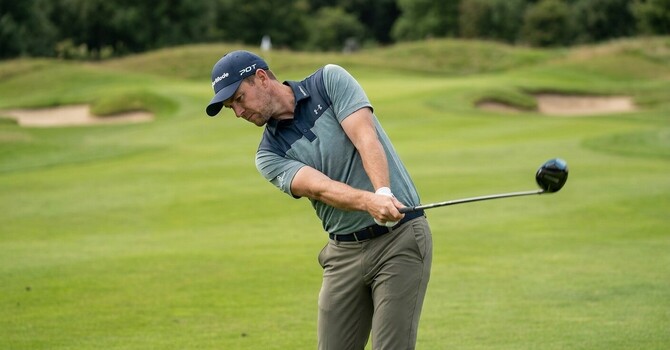
What this looks like in real life: your right side starts moving slightly differently from your left. The same hamstring keeps getting tweaked even though you stretch it religiously. Your bench press has an asymmetry you can't fix with cues. Your golf swing has lost a few yards and you have no idea why.
These are the patients we see at 417 Performance who aren't really hurt, but something's off. They've often spent months trying to figure out what's wrong. Sometimes the answer is a handful of latent trigger points quietly hijacking their movement patterns without producing any pain to flag the problem.
Needling them clears the noise. There's research showing immediate improvements in force production after needling latent trigger points in muscles like the gluteus medius. The muscle does more work with less effort because it stops fighting itself.
Two different reasons people walk in the door
Something worth saying directly, because it changes how dry needling fits into a treatment plan.
There are basically two different reasons people show up wanting dry needling, and both of them are completely valid.
Reason one: the goal is to feel better so they can keep doing what they love. The pickleball league is in season. The half marathon on the Frisco Highline is six weeks out. The dad-of-the-bride dance happens in three weeks and the lower back needs to cooperate. They aren't necessarily looking to restructure their movement from the ground up. They want the cranky tissue to calm down so they can keep training, keep playing, keep showing up. Dry needling is genuinely useful for that, and we're happy to help when that's the goal.
Reason two: the goal is to figure out why this keeps happening and address it at the source. The shoulder has flared up three times in two years. The Achilles is on its second round of pain this year. They're ready to do the slower, less glamorous work of changing how they actually move and load tissue. For these patients, dry needling becomes one piece of a bigger plan.
The research is pretty consistent on one thing: when you combine dry needling with active loading and movement work, the changes tend to stick longer than when you do either alone. A review looking at what helps after dry needling actually found that low-load eccentric exercise reduces post-treatment soreness compared to just resting. Active loading wasn't just safe afterward. It was measurably better than rest.
The way we think about it: the needle does a reset. The exercise that follows immediately afterward is what teaches the body to hang onto that reset.
A real-world example. Someone comes in with chronic Achilles pain. We needle the calf and the Achilles tendon itself, which has been shown to stimulate a healing response in degenerated tendon tissue. Within minutes, they're doing slow eccentric heel drops on a step. The eccentric loading does three useful things at once. It organizes the new collagen as it forms. It pumps the calf to clear the post-needling soreness. And it teaches the nervous system the movement pattern we want it to default to.
For someone in the "let me feel better so I can keep training" camp, dry needling might look like a quick session before practice or before a big weekend of activity. For someone in the "let me figure out why this keeps happening" camp, it might mean coupling each needling session with progressive movement work over a series of weeks. Same tool. Different game plans, depending on what someone is actually trying to accomplish.
Where this actually fits in your life
A few different points across the arc of someone's relationship with their body, basically.
During an injury or initial rehab. Dry needling has clear utility here for pain, swelling, range of motion, and force production. It's not the first thing we reach for every time, and it's never the only thing we do, but it's a legitimate tool when it fits the case.
During return to activity. This is when things get interesting. As an injury heals, the compensations that protected the injured tissue often outstay their welcome. The tissue is structurally fine. The movement pattern is still off. Needling can help clear those compensations so you don't return to activity carrying invisible inefficiencies that quietly set up your next problem.
During ongoing maintenance, before there's anything wrong. This is the part most people don't think about until they're already hurt, which is unfortunate, because it's probably where dry needling has its most underappreciated value.
There's a case series on Division I college ice hockey players who weren't injured but were training hard, accumulating fatigue, and dealing with all the normal stresses of a competitive season. A standardized dry needling recovery protocol was used between sessions. The athletes' subjective recovery scores came back closer to baseline within 48 hours of treatment compared to where they would have been otherwise (Brewster and colleagues, 2022).
These were healthy athletes. Not injured. They were using dry needling as part of their ongoing maintenance.
That model applies surprisingly well to anyone who actually uses their body for things. The person doing classes at OrangeTheory or F45 a few times a week. The runner training for a half marathon on the Frisco Highline Trail. The pickleball player who basically lives at Meador Park. The lifter at GP Athletics chasing a bench PR. Bodies that work hard accumulate stuff. Movement gets gradually compromised. The choice usually comes down to either staying ahead of it or waiting until something actually breaks.
What we see at 417 Performance is that the patients who come back for occasional check-ins after their initial care wraps up tend to deal with fewer recurring issues than the ones who only call when something is actively wrong. That's not surprising. It's still something worth saying out loud.
A few practical things if you try it
The needle itself is much thinner than what gets used for a blood draw or a vaccine. Most people don't really notice the skin penetration. What you do notice is the local twitch response when the needle finds a trigger point. It feels like a brief deep cramp or a quick aching pulse. It's gone in a second or two. That sensation is actually a useful diagnostic. It means the practitioner is in the right tissue.
Afterward, you'll probably feel sore for somewhere between 12 hours and three days. The soreness feels a lot like delayed-onset soreness from a hard training session. Some mild bruising at the insertion sites can happen. Both are normal and expected.
Not everyone is a candidate. People with serious needle phobia, certain bleeding disorders, active infections in the target area, or who are on high-dose blood thinners shouldn't get dry needling. These come up in the initial evaluation, so they're never a surprise.
The bottom line
Dry needling is a real, evidence-backed intervention with a real mechanism and a meaningful body of research behind specific applications. It isn't a miracle. It also isn't a fad. It does one thing very well, which is disrupt dysfunctional tissue and give the nervous system a window to reset.
What you do with that window depends on what you're trying to accomplish. Sometimes that's "feel better, keep moving." Sometimes that's "figure out the root cause and address it." Both are reasonable starting points, and they call for different versions of the same tool.
If you're wondering whether dry needling makes sense for your situation, that's a clinical conversation, not a marketing one. Could be about a current issue. Could be an old one that keeps coming back. Could just be whether it's worth folding into how you keep yourself running well. Different starting points, different answers, same first step.
Want to figure out if this is right for you?
Whether you're dealing with something nagging, working through an active injury, or thinking about how to stay healthy through your next training cycle, we can help you sort out what's actually going on and which tools (dry needling among them, when it fits) make sense for your specific situation.
Or call us at (417) 597-3777.
Sources
Brewster BD, Snyder Valier AR, Falsone S. A Systematic Dry-Needling Treatment to Support Recovery Posttraining for Division I Ice Hockey Athletes: An Exploration Case Series. Journal of Athletic Training. 2022;57(8):788-794. https://doi.org/10.4085/1062-6050-0096.21
Gattie E, Cleland JA, Snodgrass S. The Effectiveness of Trigger Point Dry Needling for Musculoskeletal Conditions by Physical Therapists: A Systematic Review and Meta-analysis. Journal of Orthopaedic and Sports Physical Therapy. 2017;47(3):133-149. https://doi.org/10.2519/jospt.2017.7096
Gregory TJ, Rauchwarter SA, Feldman MD. Rehabilitation Using Acute Dry Needling for Injured Athletes Returning to Sport and Improving Performance. Arthroscopy, Sports Medicine, and Rehabilitation. 2022;4(1):e209-e213. https://doi.org/10.1016/j.asmr.2021.09.035
Rabanal-Rodríguez G, Navarro-Santana MJ, Valera-Calero JA, et al. Neurophysiological Effects of Dry Needling: A Systematic Review and Meta-analysis. Archives of Physical Medicine and Rehabilitation. 2025;107(2):299-314. https://doi.org/10.1016/j.apmr.2025.08.019
Tayyab M, Ahmad Z, Tanveer M, et al. Effectiveness of Dry Needling Combined With Exercise Versus Exercise Alone in Various Tendinopathies: A Systematic Review and Meta-Analysis. Cureus. 2025;17(9):e92833. https://doi.org/10.7759/cureus.92833
.jpg)
.png)